How to Translate Shakespeare to Modern English
Shakespeare’s lines can look like a locked door. The words feel old, the order feels flipped, and the meaning hides behind both. Yet the lock has only a few parts.
If you learn to translate Shakespeare to modern English one move at a time, most lines open up fast. This guide shows the four moves, then applies them to famous lines from Romeo and Juliet, Hamlet, and Macbeth.
Try the Shakespeare Translator →
How Do You Translate Shakespeare to Modern English?
Start with four moves, always in the same order. First, swap the old pronouns for modern ones. Second, fix the verb endings. Third, unflip the word order.
Fourth, swap any leftover old words for modern ones. Work line by line, and never guess the whole sentence at once. To translate Shakespeare to modern English well, you need patience more than talent.
Keep a pencil in hand, or keep notes beside the text. Cover the modern side of a side-by-side edition, decode one line, then check your work. That loop builds speed faster than reading passively. After ten lines, the pronouns stop slowing you down.
What Do Thou, Thee, Thy, and Thine Mean?
The pronoun system causes most of the fear, but it follows one plain rule. Thou means you as a subject, as in “thou art brave” Thee means you as an object, as in “I love thee.” Thy means your before a consonant, as in “thy name.”
Thine means your before a vowel or as a standalone possessive, as in “thine eyes” or “it is thine.” Learn those four, and half the strangeness fades.
Thou was the informal form, used with friends, children, or social inferiors. You was the formal form, used with strangers and superiors. When a character switches from you to thou, that switch often marks anger or new intimacy. Watch for it, because it changes the scene.
How Do You Unflip Shakespeare’s Word Order?
Shakespeare often puts the verb or the object before the subject. Modern English almost always runs subject, verb, object.
To decode a flipped line, find the verb first, then ask who does it. Move the subject to the front, and the line usually turns plain. Verb endings help here too, since -eth marks he, she, or it, and -est marks thou.
Take “wherefore art thou Romeo” as the classic test. Wherefore means why, not where. Art means are, and thou means you.
Put the subject first, and the line reads “why are you Romeo.” Juliet is not asking where he is. She asks why he must be a Montague.
What Does “Wherefore Art Thou Romeo” Really Mean?
Juliet speaks this line on the balcony in Romeo and Juliet. Her family hates his family, and his name alone blocks their love. She wishes he had any other name, so the feud would not touch them.
That wish is the whole point of the speech. Students who read wherefore as where miss the scene entirely, so this one line is worth learning by heart.
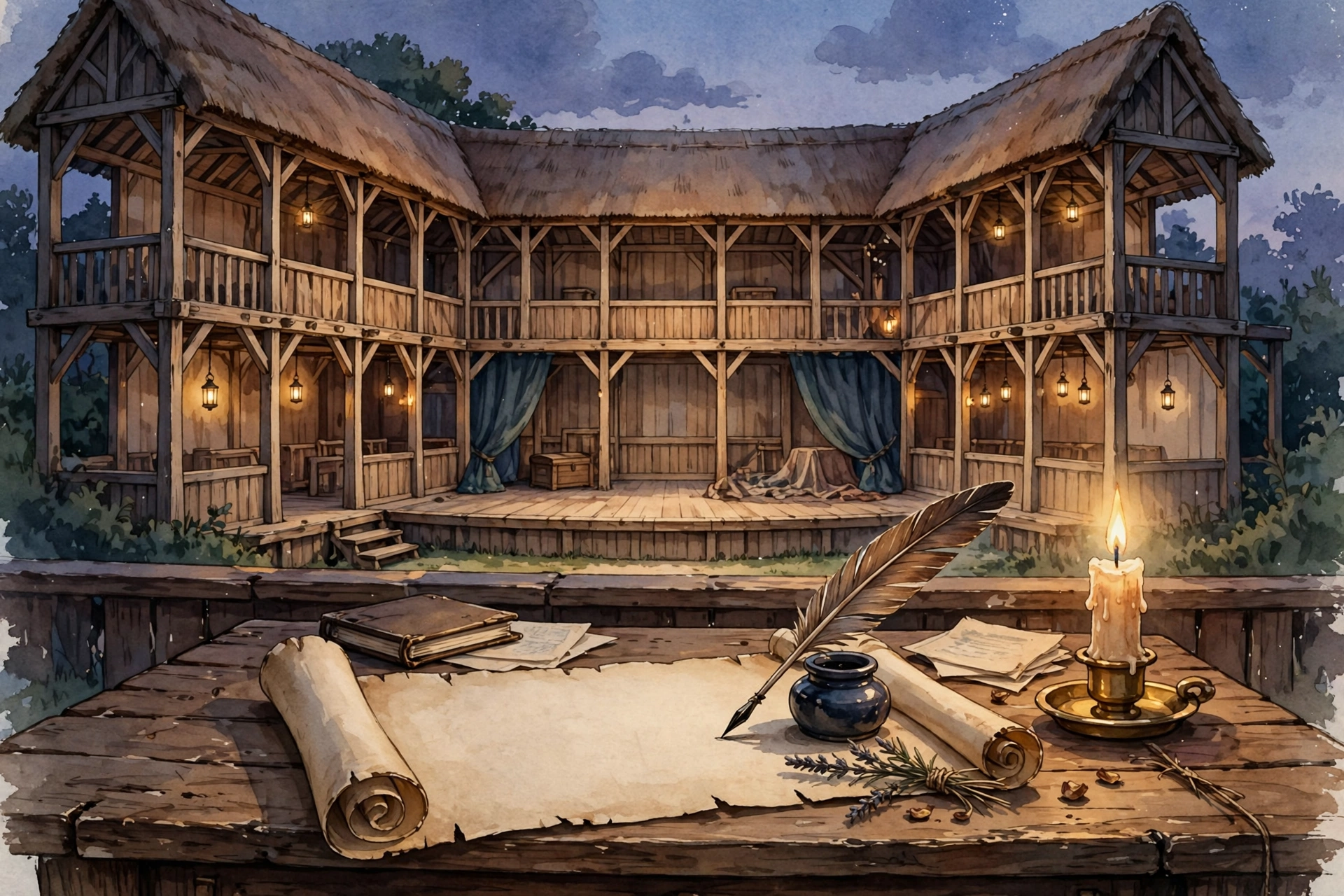
His company performed at the Globe Theatre in London, an open-air playhouse on the Thames. The stage had no sets and little scenery, so the words carried everything. That is one reason the language feels so dense. Every image had to live in speech, not in staging.
How Do You Decode Hamlet, Macbeth, and Other Plays?
Hamlet gives the most famous test line of all. “To be, or not to be” asks whether life is worth its suffering. In modern English, it reads “should I live or die.”
Hamlet weighs that question through the whole soliloquy, so the single line only opens the speech. Read the lines around it before you settle on a meaning.
Macbeth gives a louder test. The witches chant “double, double toil and trouble” as they brew their potion. In modern English, that reads “double the hard work and the mischief.”
The chant sounds like nonsense until you decode it, then it turns into a plain recipe for trouble. The same four moves work on any play, from Romeo and Juliet and Hamlet to Macbeth, The Merchant of Venice, and Twelfth Night.

Start with short speeches before you tackle a full scene. A sonnet gives you fourteen lines of practice in one page. A single balcony speech gives you feeling and argument together. Short wins build the habit that long scenes need.
How Can Worksheets and Side-by-Side Texts Help?
Worksheets work because they force the four moves in order. A good sheet puts the Shakespearean line on one side and a blank on the other. You fill the blank, then check it against the answer key.
Teachers use this format because it turns decoding into a skill, not a guessing game. If you translate Shakespeare to modern English on a worksheet, do five lines a day rather than fifty in one sitting.
Side-by-side editions help in the same way. The original sits on the left, and the modern version sits on the right. Read the original first, cover the modern side, and decode before you peek.
The Folger Shakespeare Library offers free online texts that help you check your decoding line by line. If you also want to speak the lines aloud, our guides to saying hello and talking like Shakespeare show the forward direction.
Frequently Asked Questions
How can I understand Shakespeare in English?
Start with the pronouns and the word order, since those two moves unlock most lines. Then read a short speech aloud, slowly, before you look at any modern version. Hearing the rhythm helps the meaning land. Use a side-by-side edition only to check your work, not to replace it.
When you translate Shakespeare to modern English for homework, start with the shortest speeches.
What are some Shakespearean words?
Prithee means please, or I pray thee. Anon means shortly or soon. Hark means listen.
Wherefore means why. Gramercy means thank you, from the French grand merci. Learn ten such words, and whole speeches start to feel familiar.
Is there a free translator app for Shakespeare?
You need no app and no account to try the tool on this site, since it runs free in any browser. That tool converts modern English into Shakespearean English. For the reverse direction, this guide teaches the manual method, because decoding by hand builds the skill that a button cannot teach.
What is Shakespeare’s English called?
It is called Early Modern English, the stage of the language that ran from roughly 1500 to 1700. It sits between Middle English, the language of Chaucer, and the Modern English we speak today. Calling it Old English is a common error, since Old English is the far older Anglo-Saxon tongue.
Try It in the Shakespeare Translator
Pick one line from this guide and decode it yourself before you check anything. Then try writing your own line in the forward direction, and see how the pronouns and verb endings feel from the other side. If you translate Shakespeare to modern English every day for a week, the fear fades fast. You can find more translators in our Historical English collection.